

If you're planning to build custom software in Nepal, one question comes before all the others: what will it cost?...



Custom software development can take anywhere from a few weeks to more than a year, depending on the project’s scope, complexity, features, integrations, and platforms.
As a general guide, a simple business application may take 1–3 months, a medium-complexity system around 4–7 months, while a SaaS platform, ERP, CRM, or enterprise application can take 6–18 months or longer.
For businesses considering custom software development in Nepal, however, the more useful question isn’t simply how many months development will take. It is what needs to be built, how complex the requirements are, and what the first usable version should include.
A clear scope at the beginning can make a significant difference to both the development timeline and the final cost.
Custom Software Development Timeline at a Glance
Here is a general estimate for different types of custom software projects:
| Type of Software | Typical Development Time |
| Simple business software | 1–3 months |
| Small custom application | 2–4 months |
| Medium-complexity software | 4–7 months |
| SaaS MVP | 3–6 months |
| Full SaaS platform | 6–12+ months |
| CRM or ERP system | 6–12+ months |
| Enterprise software | 9–18+ months |
These are general ranges rather than fixed deadlines.
The actual timeline for a software project in Nepal can vary considerably. A relatively small application with complicated integrations may take longer than a larger application with straightforward functionality.
The number of screens also isn’t a reliable way to estimate development time. The complexity of the business logic, integrations, user roles, security, and workflows behind those screens matters much more.
Several factors influence how long it takes to build custom software.
The first factor is what the software actually needs to do.
A basic internal application with user accounts, dashboards, records, and simple reporting is relatively straightforward.
A business system with:
requires considerably more development and testing.
This is particularly important when estimating a custom software project for a business in Nepal. Two companies may ask for a “business management system,” but their actual requirements can be completely different.
One may need a simple internal tool. Another may need inventory, accounting, purchasing, sales, reporting, mobile access, and multiple integrations.
The name of the software does not determine the timeline. The requirements do.
The work behind the interface can have a major impact on the development timeline.
For example, a basic inventory application might allow employees to add products, update stock, and view reports.
A more advanced inventory system may need to:
The interface may still look relatively simple to the end user, but the underlying system is much more complex.
This is why an accurate software development estimate should be based on requirements rather than simply counting pages or screens.
One of the biggest factors affecting a custom software development timeline is how clearly the requirements are defined.
Before development begins, the team needs to understand:
Requirements can evolve during development, and that is normal.
However, major changes after development has already started can introduce additional design, development, testing, and deployment work.
In our experience, projects don’t necessarily run over schedule simply because they are complex. Projects are much more likely to become difficult to predict when requirements remain unclear or keep changing after development has started.
That is why the initial discovery and planning stage is so important.
Modern business software often needs to connect with existing platforms.
Depending on the project, this could include:
Some integrations are relatively straightforward. Others require additional development because of API limitations, authentication requirements, external approvals, data inconsistencies, or technical restrictions.
For Nepali businesses, integrations with existing accounting, payment, banking, attendance, or local business systems can therefore be an important part of the initial timeline assessment.
Design is another part of the overall software development process.
Depending on the project, it may include:
An internal business application may require a relatively straightforward interface.
A customer-facing SaaS product may need considerably more work around onboarding, dashboards, navigation, responsive design, and different user experiences.
The platform or platforms being developed for also affect the timeline.
A web application has different requirements from a product that needs:
Developing for multiple platforms introduces additional development, testing, compatibility, deployment, and maintenance requirements.
If the business only needs a web application initially, launching that version first can sometimes reduce the time required to get the product into use.
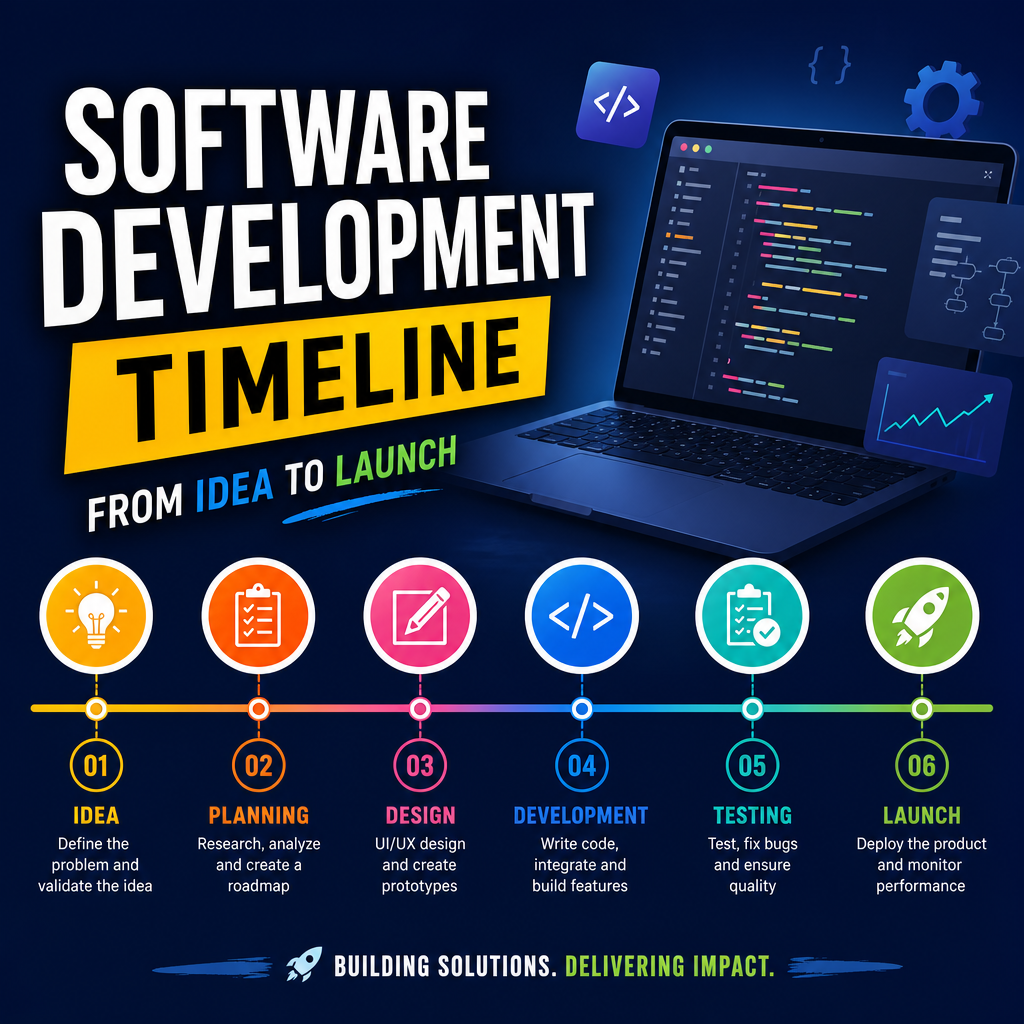
A typical custom software development process includes:
Discovery → Planning → UI/UX Design → Development → Testing → Deployment → Maintenance
The stages can overlap, particularly when a team follows an agile development process, but each contributes to the overall timeline.
The first stage is understanding the business problem and defining what the software needs to accomplish.
This may involve:
For a small project, this stage may take days or a few weeks.
For a more complex system, requirements analysis can take considerably longer.
This stage is particularly valuable when developing custom software because it gives the development team an opportunity to identify technical challenges before significant development work begins.
Once the requirements are understood, the team can design how users will interact with the software.
This may include wireframes, prototypes, high-fidelity designs, responsive layouts, and design systems.
For software used by customers or employees every day, investing enough time in UX can prevent usability problems that would otherwise appear after development.
This is where the approved requirements and designs become a working application.
Development may involve:
The development phase usually represents a significant portion of the overall timeline.
The exact duration depends heavily on the scope and technical complexity of the project.
Software isn’t finished simply because the features have been coded.
The application needs to be tested for:
Testing can happen throughout development rather than only at the end.
For complex software, this becomes increasingly important because a change in one part of the system can affect another.
Once the software has been tested, it needs to be prepared for real users.
Deployment may involve:
The actual deployment may be relatively quick, but preparing a production environment for a complex system can require additional planning.
The exact timeline depends on the project, but looking at common categories can make the ranges easier to understand.
A relatively simple business application may take around 1–3 months.
For example, a company might need a system to manage customers, employees, records, tasks, basic reports, and user accounts.
If the requirements are clear and there are few external integrations, this type of project can be relatively straightforward.
Additional automation, advanced reporting, payment systems, integrations, or mobile applications can increase the timeline.
Medium-complexity software commonly takes around 4–7 months.
These projects may include:
A business management platform used by employees, managers, customers, and administrators could fall into this category.
A Minimum Viable Product (MVP) can often take approximately 3–6 months, depending on its scope.
An MVP should not simply be a stripped-down version of a finished product. It should be the smallest useful version that allows a business to test its core idea with real users.
For example, a SaaS product might eventually need advanced analytics, multiple integrations, automation, mobile applications, complex permissions, billing, and AI functionality.
The first version may only need the core workflow, user registration, a basic dashboard, administration, and essential payment functionality.
Keeping the first release focused can help a business launch earlier and use real customer feedback to guide future development.
A SaaS MVP may take approximately 3–6 months, while a more complete SaaS platform can take 6–12 months or longer.
SaaS products often have additional technical requirements because one platform may serve many customers.
Depending on the product, this can include:
A multi-tenant SaaS platform, where multiple businesses use the same application while keeping their data separated, can introduce additional architectural and security considerations.
Custom ERP and CRM systems can take around 6–12 months or longer, depending on the modules and integrations involved.
A basic CRM might include contacts, leads, sales pipelines, tasks, notes, and reports.
A more advanced system could add marketing automation, email integration, customer portals, payment integration, sales forecasting, advanced analytics, and custom workflows.
ERP systems can be even more complex because they may connect different areas of a business, such as:
For larger systems, development is often divided into modules and released in phases rather than delivered all at once.
Large enterprise software projects can take 9–18 months or longer.
Longer timelines are often associated with:
Enterprise software is generally better developed in phases so that important functionality can be delivered before the entire roadmap is complete.
A software project can fall behind schedule for reasons that have little to do with coding.
Changing requirements
Adding major functionality after development has started changes the original scope.
Slow feedback and approvals
Design approvals, business decisions, content, and clarification from stakeholders can all affect progress.
Unclear requirements
If important business rules are discovered only after development begins, the team may need to revisit existing functionality.
Third-party dependencies
APIs, payment providers, hardware, application stores, and other external services can introduce dependencies outside the development team’s control.
Data migration
Moving information from an old system can require additional work when the existing data contains duplicates, missing information, inconsistent formats, or outdated records.
Scope creep
A project that starts as a simple application can gradually become a much larger system as new features are added.
The best way to manage these risks is to define the initial scope clearly and separate essential functionality from future improvements.
Yes, but reducing the timeline should not mean skipping essential design, testing, or quality assurance.
One of the most effective ways to launch sooner is to reduce the initial scope.
Instead of building every planned feature in the first release, the project can be divided into phases.
Phase 1: Core product
Build the functionality required to solve the primary problem.
Phase 2: Launch
Release the first version to the intended users.
Phase 3: Feedback
Learn how people actually use the software and identify improvements.
Phase 4: Expansion
Add secondary features, integrations, automation, and other improvements.
This approach can help businesses reach their first launch sooner while reducing the risk of spending heavily on features that users may not need.
Adding more developers can sometimes accelerate a project, but it doesn’t automatically make development faster. Communication, architecture, coordination, testing, and project management become increasingly important as the team grows.
Not necessarily.
The country where software is developed does not by itself determine the development timeline.
For businesses considering custom software development in Nepal, the more important factors are:
Nepal has an established software development industry serving both local and international businesses. A business considering an offshore or Nepal-based development team should therefore evaluate the provider based on its capabilities and relevant experience rather than simply comparing hourly rates.
Before choosing a software development company in Nepal, consider asking:
The right development partner should be able to explain not only how long a project may take, but also what is included in that timeline.
Development time and software cost are closely connected, but they aren’t exactly the same.
A six-month project doesn’t necessarily cost twice as much as a three-month project.
The total cost can depend on:
If you’re also researching the cost of building custom software in Nepal, see our guide:
Custom Software Development Cost in Nepal: 2026 Pricing Guide
Understanding both the timeline and cost gives you a more realistic picture of what a software project will require.
A development company can provide a more accurate estimate after understanding your actual requirements.
Before requesting a software development proposal, it helps to prepare:
Business objective
What problem should the software solve?
Target users
Who will use the application?
Core features
What does the first version absolutely need to do?
User roles
Who can access which features?
Integrations
Does the software need to connect with existing systems or third-party services?
Platforms
Do you need web, Android, iOS, desktop, or multiple platforms?
Design requirements
Do you already have UI/UX designs, or will the development team handle the design?
Future requirements
Which features may be needed later but don’t need to be part of the first release?
The clearer these requirements are, the easier it is for a development team to separate essential functionality from future improvements and provide a realistic estimate.
A common mistake is trying to estimate the entire product before deciding what the first release actually needs to accomplish.
A more practical approach is to divide the roadmap into three categories:
Must-have features
Essential for the first usable version.
Should-have features
Useful improvements that can potentially be introduced after launch.
Future features
Ideas that may be valuable later but shouldn’t delay the initial release.
For example, a business planning a management platform may eventually want dozens of reports, automated workflows, mobile applications, AI features, and multiple integrations.
The first release may only need the core workflow and a few essential reports.
Launching that version earlier gives the business an opportunity to learn from actual users before investing in the rest of the roadmap.
The timeline for custom software development ultimately depends on what you need to build.
A simple business application may take a few months, while a complex SaaS platform, ERP, CRM, or enterprise system can require significantly longer.
At Imagio Creations, we’ve worked on software projects with different levels of complexity, and one of the biggest differences between predictable and unpredictable projects is how clearly the scope is defined before development begins.
Planning a new software product, replacing an existing system, or looking to automate your business? We can help you define the requirements, development roadmap, timeline, and budget. Get in touch or message us on WhatsApp.
If you're planning to build custom software in Nepal, one question comes before all the others: what will it cost?...

Yes, outsourcing software development to Nepal is safe: provided you choose the right partner. Nepal has a large pool of...
Nepal has become one of South Asia's most capable software development destinations. Local businesses are going digital faster than ever,...
